That Exit Headline You Just Read? It Is 113 Days Old.
⚡ Three-Line Summary
- Both voiding conditions we published this week fired, and we deleted nothing. The index set two records and seven of seventeen names still fell.
- A full rescan found not three builds but twelve, across three weeks, roughly four million contracts, with the payout centre walking from 10.7% below the index to 38.3% below. Every one of them was visible the day it happened.
- Friday's 13F describes trades from six weeks ago. Same question, two answers: a price posted on the chain on July 24 does not reach a filing until November 14, one hundred and thirteen days later.
What This Issue Covers
Sections 1 to 3 are the week's three highlights: how we booked the calls we got wrong, seven of seventeen falling under record highs, and the twelve price lists laid down over three weeks. Section 4 is why Friday's 13F is old news. Sections 5 to 7 are how the same question is answered on the chain the same day, and how to read it if you already hold the stock.
[Scoreboard] Two Calls Overturned. Nothing Deleted.
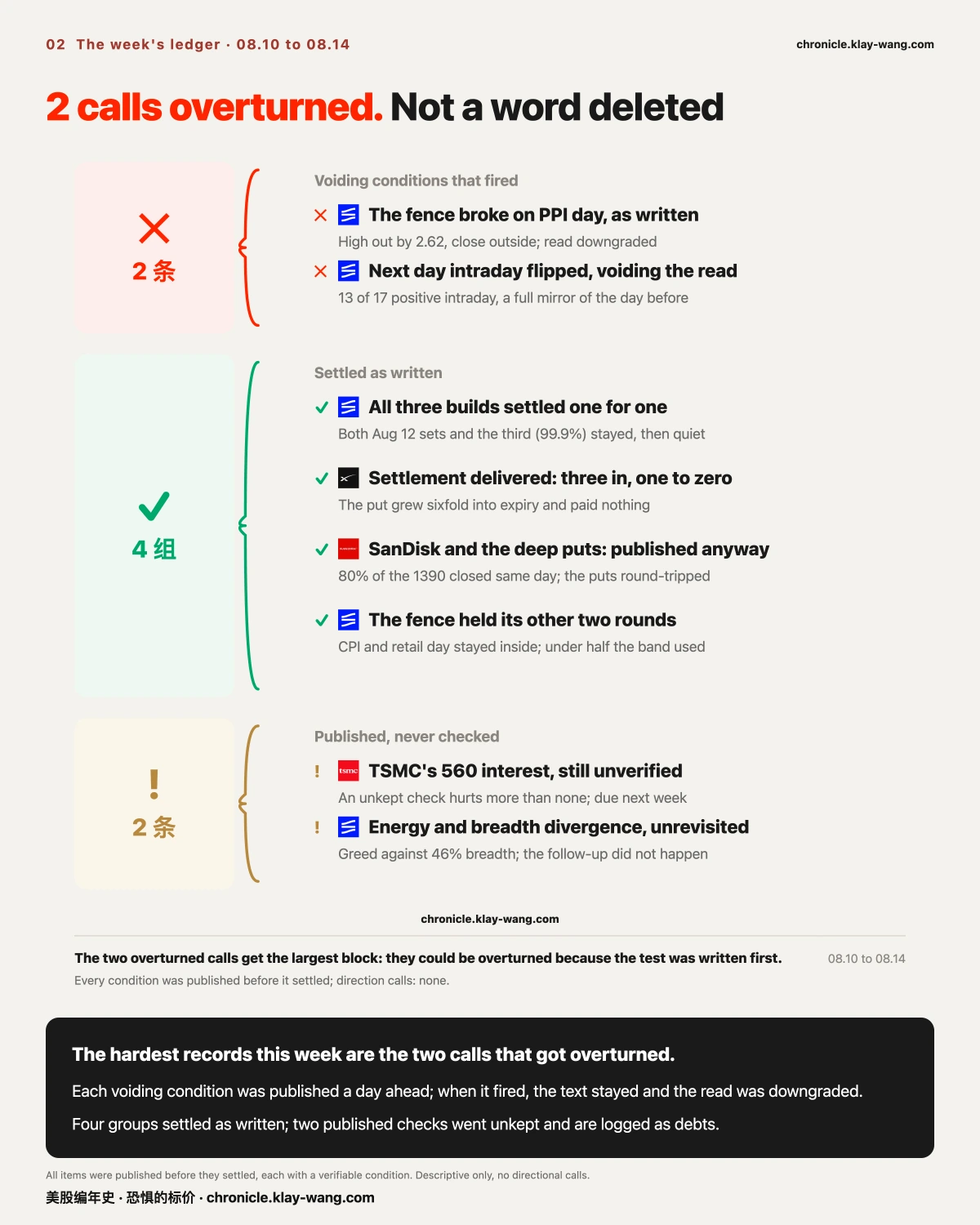
On CPI day the pre-posted fence held and we wrote that the market had priced the event correctly. In the same section we published the condition that would void it: if the same fence broke on PPI day, that was a lucky hit rather than a correct price.
It broke the next day. SPY cleared the upper edge by 2.62 points and closed outside. By our own rule the reading was downgraded that day, and the text stayed.
The cross-section call fired the same way. We had written that Wednesday's selling was an event-day shape, void if intraday turned broadly positive the next day. Thirteen of seventeen printed positive intraday.
Four groups settled as written; two published checks went unkept and are logged as debts. A call that cannot be overturned is not a call.
[Cross Section] Two Records Above, Seven Names Falling Below
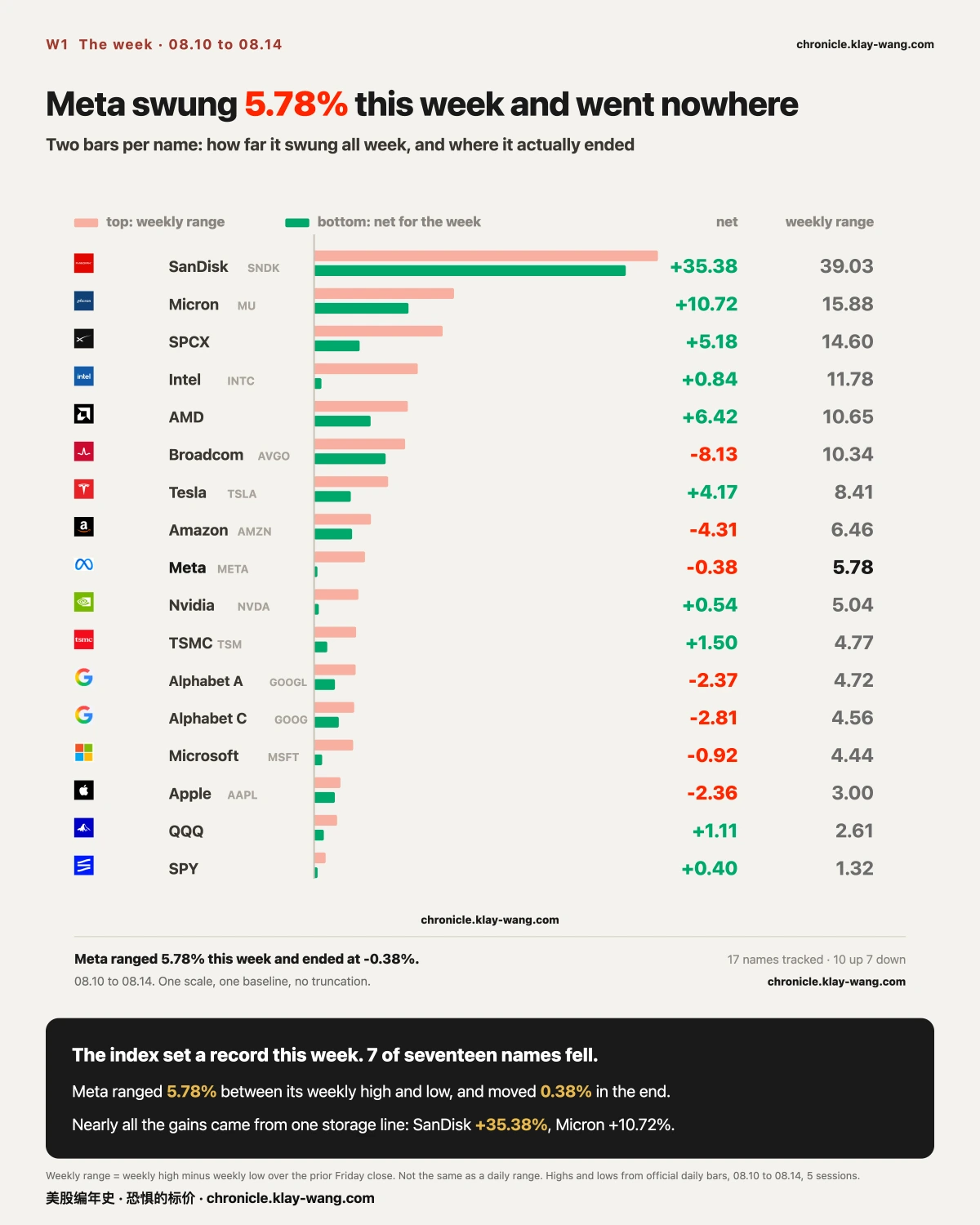
SPY rose 0.40% for the week and QQQ 1.11%, with records on Wednesday and Thursday. Seven of our seventeen names still fell.
The ends are far apart: SanDisk +35.38%, Micron +10.72%, AMD +6.42% at one end; Broadcom −8.13%, Amazon −4.31% at the other. Forty-three points between them. That 0.40% is what remains after all of it cancels out.
One number matters more than the change: the weekly range. Intel finished up 0.84%, almost still, on a range of 11.78%. It walked a twelve-point corridor and came back near where it started. Anyone holding it saw two prices more than a tenth apart.
The change is displacement. The range is the distance actually travelled. For one name in one week the two can differ tenfold.
On the cost side: front volatility fell from 15.46 to 14.25, down 1.21 points, while the one-year went 22.76 to 22.75, a move of 0.01. The front is mood, the far end is cost. Only the mood eased.
[Depth] Not Three Builds. Twelve, Over Three Weeks.
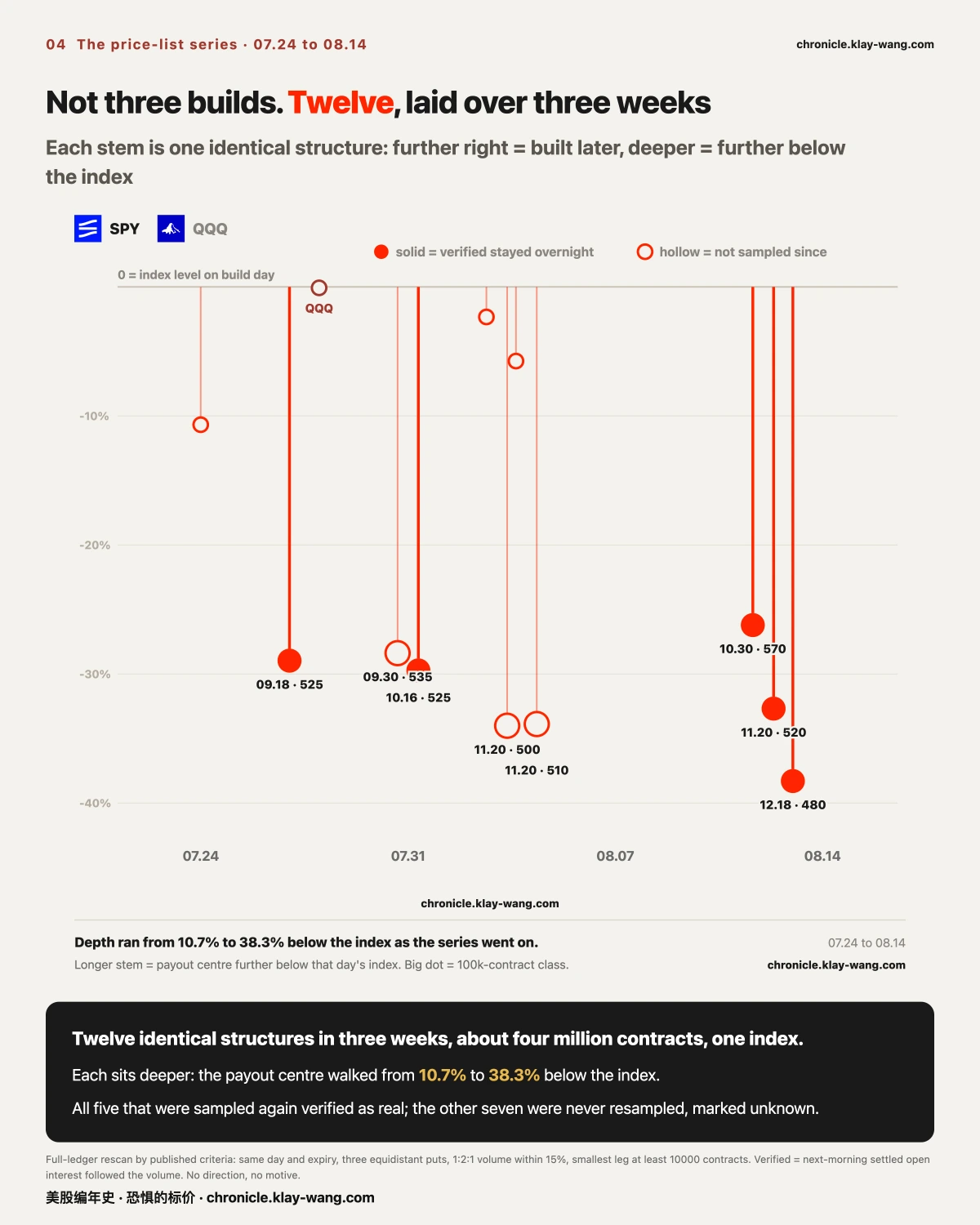
We wrote about three identical structures in this week's dailies. Over the weekend we rescanned the full table on the same published test: one day, one expiry, three evenly spaced put strikes, sized one to two to one, smallest leg above ten thousand contracts.
The answer is twelve, from July 24 to August 13, roughly four million contracts, eleven on SPY and one on QQQ.
Two shapes only appear once you line them up. The November 20 expiry was built three times, on August 3, 4 and 12, each one shifted 10 points higher as the index rose. And they went deeper: the payout centre moved from 10.7% below the index to 38.3% below.
Five have been resampled and all verified. The other seven were never resampled and are marked unknown.
The limits stand: we do not name the structure, guess who did it, or infer direction. Shape and what stayed overnight are all we can speak to.
But one thing these twelve already settle: over three weeks, somebody repeatedly wrote down, in the open, the position at which they wanted to be paid if it fell. Every one of those was visible the same day.
[13F] The News Is New. The Trades Are Not.
That is the whole point of the previous section: those twelve were visible on the day. The volume sits there when it is built, and the next morning's open interest answers whether it was real. Anyone can check.
This week also produced the opposite kind of information.
Friday was the second-quarter 13F deadline, which is why your feed filled with headlines about who exited what.
A 13F is a quarter-end snapshot. Q2 closed on June 30 and the filing window is 45 days, landing on Friday. The documents are new; the trades inside them are six weeks old.
Two more things it does not tell you: when the position was opened, and at what price. You only see what was left at quarter end.
[The Other Route] The Chain Answered on the Day
One place needs no six-week wait. A contract states exactly what a 13F omits: what price, and by when.
On July 24 our long-dated screen logged a SpaceX put, December 18 expiry, strike 115: 1109 contracts traded against 7447 standing. The next settlement showed 8398, up 951, keeping 85.8% of that day's volume, which by our fixed test is a real build.
We did not know whose it was. A month later Duan Yongping said publicly that he had sold 1000 of them at 23.26 per share. Our ruler read 951. His own number was 1000.
The part most people get wrong is not the 2.326 million dollars received. It is that his cost to take delivery is not 115. It is 91.74, because the 23.26 came in first.
Twelve days later SpaceX closed at 108.27, down 13.61% on earnings day, with an intraday low of 106.66. He did not wait to be assigned. He bought 100,000 shares outright. What he said and what he did were the same thing.
That price was visible on the chain on July 24. It will not appear in a filing until November 14. One hundred and thirteen days apart.
[How to Read It] If You Already Hold the Stock
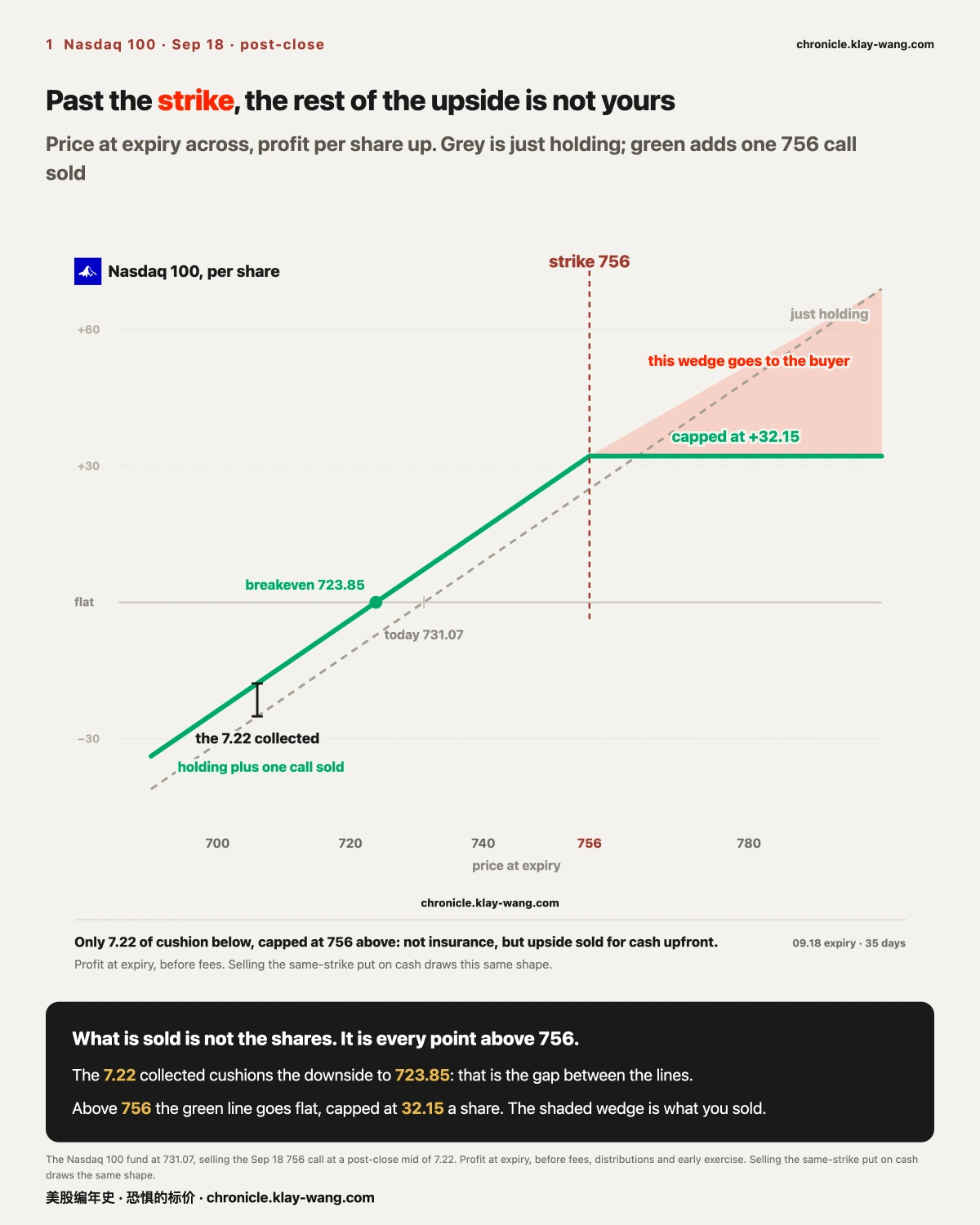
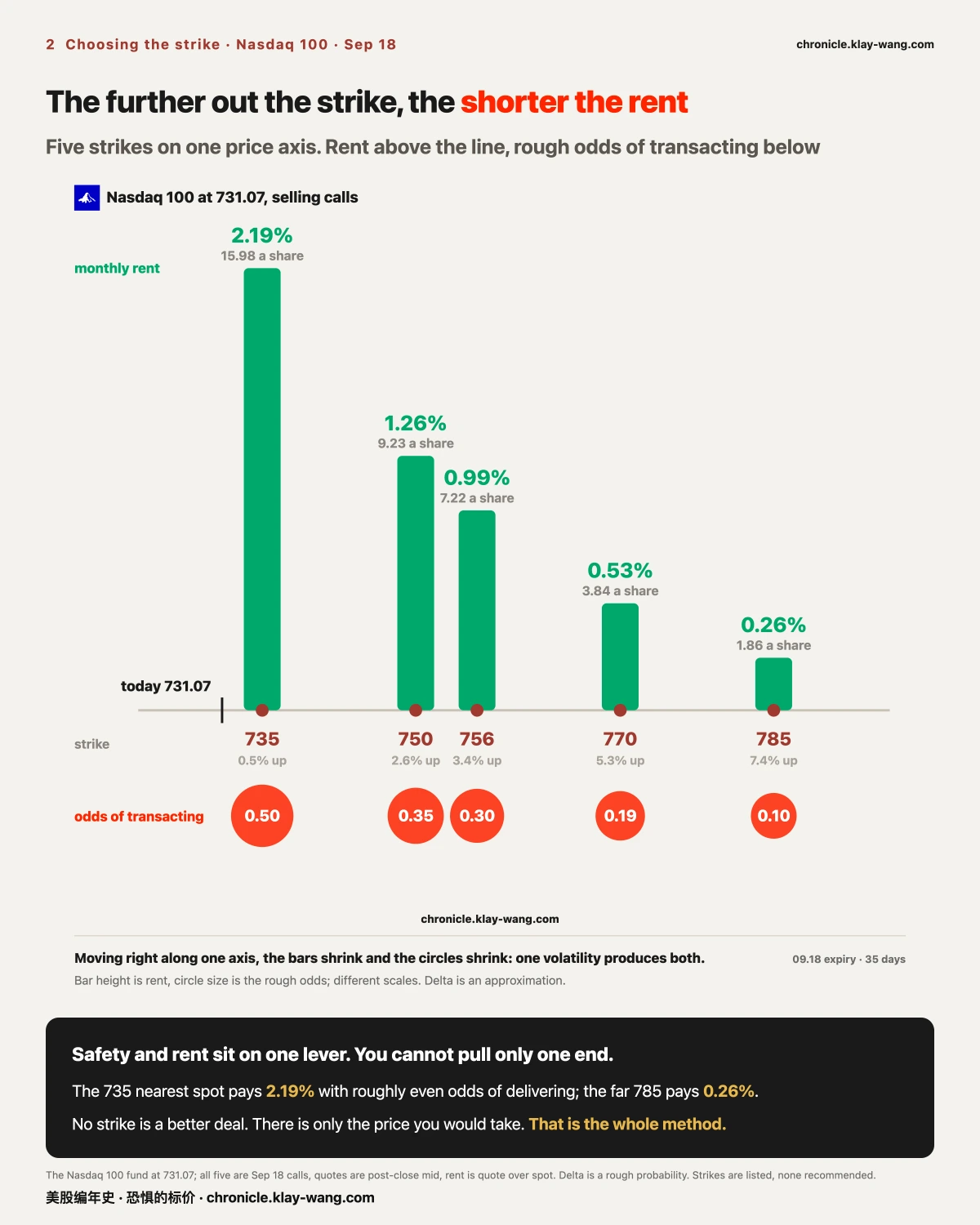
Scale is not the point; the method is. Same underlying, same expiry, only the strike changes. Real quotes on the Nasdaq 100 fund after the August 14 close: at a 0.50 chance of assignment, strike 735, 0.5% above spot, one month of rent 2.19%. At 0.30, strike 756, 3.4% above, 0.99%. At 0.19, strike 770, 5.3% above, 0.53%. At 0.10, strike 785, 7.4% above, 0.26%.
Safety and rent are two ends of one lever. You cannot pull only one.
So no strike is the better deal. There is only one question: would you actually be happy to transact at that price. If yes, that is your strike. If no, the rent does not matter.
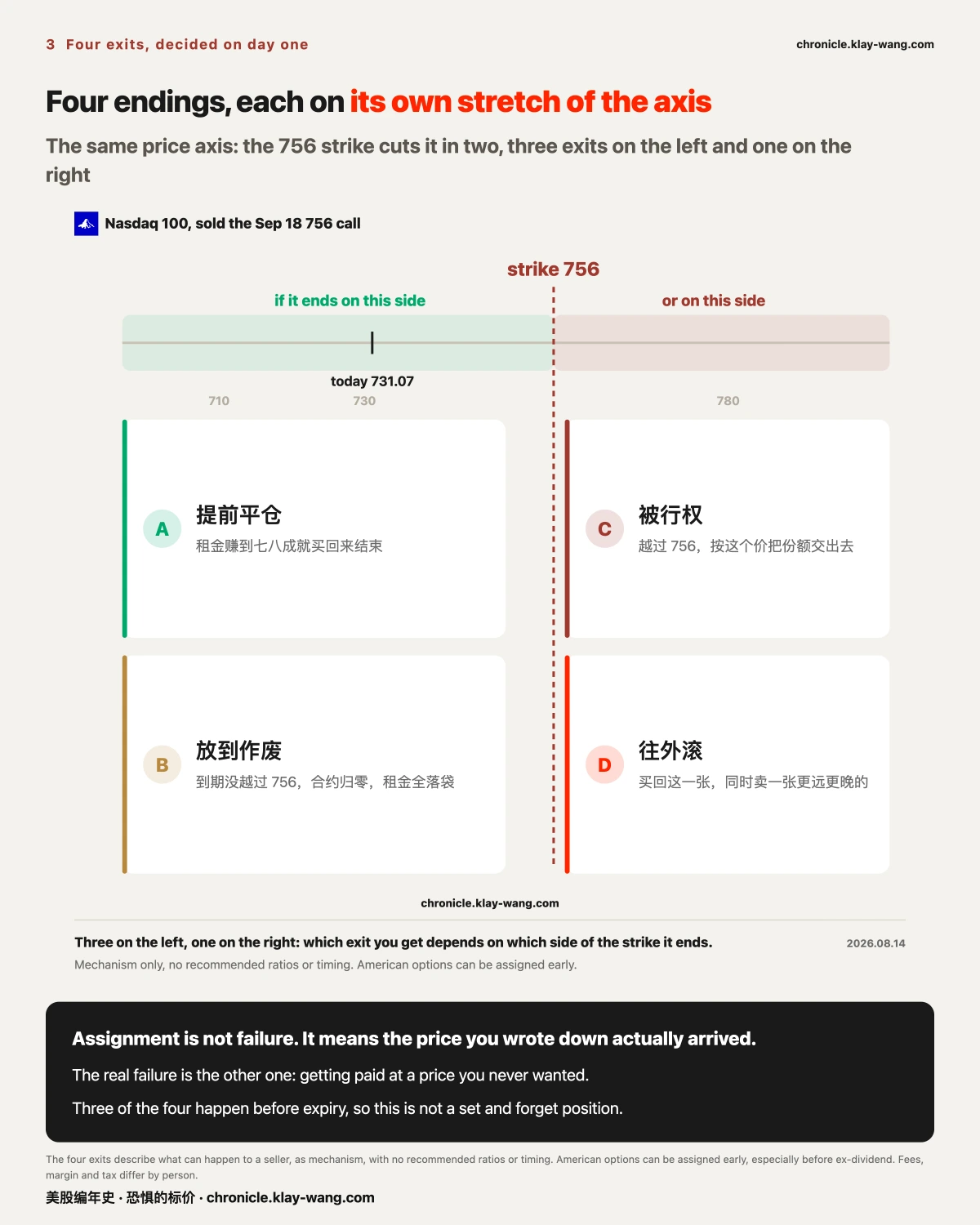
Four exits exist, and all four are on the table the moment you open: close early once most of the rent is earned; let it expire worthless and keep the stock; be assigned at the price you wrote down; or roll further out. Three of the four happen before expiry.
Assignment is not failure. It is the price you chose arriving. The real failure is collecting money at a price you never wanted, and finding out only when it gets there.
⚠️ An options seller carries the obligation to be assigned, and US-style options can be assigned early. This section is about reading the numbers, not about what to buy.
[Next Week] Most of This Week's Files Settle on Friday
Reddit joins the S&P 500 before Tuesday's open. The announcement-day gap of 11.17 points is already on record; the effective-day gap is its counterpart, and the two are priced in completely different ways.
Wednesday is the volatility futures roll, so read the curve's shape that week together with the rolling effect.
Friday is the monthly expiry, when most of the contracts logged this week settle at once.
Three Lines Worth Keeping
- A filing tells you what they bought. The chain tells you what price they were willing to pay. The first takes 113 days; the second is there the same day.
- The real cost of that trade is not the strike. It is the strike minus what came in first: 115 less 23.26 is 91.74.
- Safety and rent are two ends of one lever. No strike is the better deal; there is only whether you would be happy to transact there.
No investment advice. No direction calls. No market timing.